
How to Rank on Google in 2026: An Honest Guide for Kolkata Business Owners
 Digital Marketing
 Let me start with a confession most SEO agencies won’t make: ranking on Google in 2026 is harder than it was five years ago — and easier at the same time.
Harder, because Google’s results page is now crowded with AI Overviews, ads, maps, and “People Also Ask” boxes before a single regular website link appears. Easier, because most of your competitors in Kolkata are still doing SEO the way it was done in 2019. If you simply do things the current way, you leapfrog half the market.
I’ve spent years working with businesses across Kolkata — sweet shops in Bhowanipore, coaching centres in Salt Lake, interior designers in New Town, boutique hotels near Park Street — and the pattern is always the same. The owners who rank aren’t the ones spending the most money. They’re the ones who understand how people in this city actually search, and who stopped chasing shortcuts.
So this is the honest version. No jargon dumps, no “10 secret hacks,” no promises of page one in 30 days (anyone promising that is lying to you, and you should walk away politely). Just what genuinely moves the needle if you want to learn how to rank on Google in Kolkata in 2026.
First, Understand What Changed: You’re Not Just Ranking for Google Anymore
Here’s the biggest shift, and it deserves to be said plainly.
In 2026, when someone in Kolkata searches “best CA firm near me” or “affordable interior designer New Town,” they often don’t scroll through ten blue links. They read Google’s AI Overview at the top, glance at the map pack, and make a decision. Many people skip Google entirely and ask ChatGPT, Perplexity, or Gemini instead.
This means your job has quietly expanded from “rank on Google” to “be the business that search engines and AI tools mention when someone asks a question in your category.”
The good news? The work that gets you cited by AI is largely the same work that gets you ranked on Google. Clear answers, genuine expertise, a strong local footprint, and a website that doesn’t make Google guess what you do. Keep that in mind as we go — everything below serves both goals.
Step 1: Your Google Business Profile Is Your Real Homepage
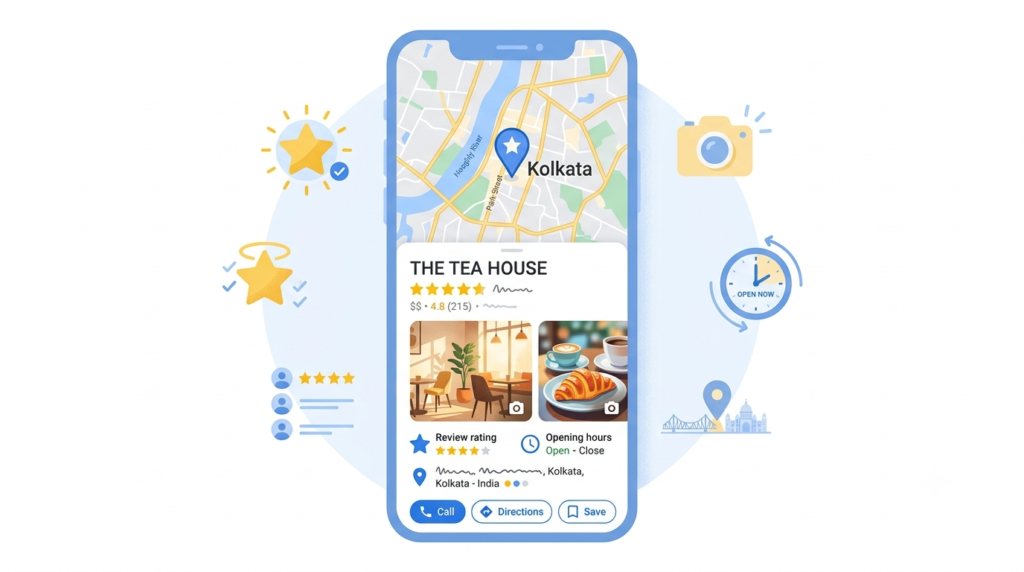
If you run a local business in Kolkata and you only have energy for one thing this month, make it this.
For searches like “dentist Ballygunge” or “wedding photographer Kolkata,” the map pack (those three business listings with the map) gets the lion’s share of clicks. Your website comes second. Your Google Business Profile comes first.
Here’s what an optimized profile actually looks like in 2026:
Complete every single field. Category (primary and secondary), services, service areas, hours, holiday hours during Durga Puja and Diwali, attributes, payment methods. Google rewards completeness because incomplete profiles create bad user experiences.
Get reviews consistently, not in bursts. Twenty reviews in one week followed by silence for six months looks manipulated. Two to four genuine reviews every month, replied to personally, looks like a healthy business. When a customer at your Gariahat store says something nice, that’s the moment to ask — “Would you mind putting that on Google? It really helps us.” Most happy customers say yes when asked in person.
Reply to every review — including the bad ones. A calm, professional reply to a one-star review does more for your reputation than ten five-star reviews. Future customers read those exchanges.
Post weekly. New menu item, festive offer, a project you completed, even a photo of your team during Poila Boishakh celebrations. Activity signals a living business.
Upload real photos. Not stock images. Your actual shopfront on that actual Kolkata street, your actual team, your actual work. Google’s image recognition can tell the difference, and so can customers.
I’ve seen a small physiotherapy clinic in Behala go from invisible to the top of the map pack in about four months doing nothing but the above. No backlinks, no fancy website. Just a properly worked Google Business Profile.
Step 2: Fix the Boring Stuff on Your Website (It’s Less Boring Than Losing Customers)
Before we talk content and keywords, your website needs to pass three basic tests. Most Kolkata business websites I audit fail at least one.
Test 1: Does it load fast on a mid-range phone on mobile data? Not your iPhone on office WiFi — a ₹15,000 Android on a 4G connection in a crowded area, because that’s how a huge share of your customers browse. If your site takes more than three seconds, people leave, and Google notices they leave. Compress your images (this alone fixes most slow Indian business sites), remove plugins you don’t use, and get decent hosting.
Test 2: Can Google tell what you do and where you do it within five seconds? Open your homepage and pretend you know nothing. Does the first screen say something like “Bespoke Furniture Manufacturer in Kolkata — Serving Salt Lake, New Town & Rajarhat”? Or does it say “Welcome to our website” over a stock photo of a handshake? Google ranks pages, not intentions. Say what you do, plainly, in the words your customers use.
Test 3: Is your name, address, and phone number identical everywhere? Your website footer, your Google Business Profile, Justdial, IndiaMART, Facebook — same spelling, same format. “21A, Sarat Bose Road” on one platform and “21/A Sarat Bose Rd” on another confuses the systems that verify you’re a real, trustworthy local business. Pick one format and enforce it everywhere.
None of this is glamorous. All of it is foundational. Skipping it is like decorating a shop with a broken front door.
Step 3: Write for the Questions Kolkata Actually Asks
Here’s where most business owners get keyword strategy wrong: they chase the biggest, broadest term. A CA firm wants to rank for “chartered accountant.” A gym wants “gym Kolkata.” These terms are brutally competitive, and — here’s the part nobody mentions — they often don’t even convert well, because the searcher’s intent is vague.
The money is in specific, local, question-shaped searches:
- “GST registration for small business Kolkata cost”
- “ladies gym with trainer Salt Lake Sector 5”
- “banquet hall for 200 guests South Kolkata price”
- “interior designer for 2BHK flat New Town budget”
Notice the pattern? Location + specificity + intent. The person typing “banquet hall for 200 guests South Kolkata price” is booking a venue soon. The person typing “banquet hall” might be writing a school essay.
So here’s your content plan, and it’s simpler than any agency will make it sound:
- List the 20 questions customers ask you on the phone or over the counter. You already know them. “Do you deliver to Howrah?” “What’s the price for X?” “How long does Y take?” “Do you handle Z?”
- Answer each one in a genuinely helpful page or blog post, in plain language, with real numbers and real examples where you can share them.
- Give a direct answer in the first two or three sentences, then elaborate. This structure is exactly what Google’s featured snippets and AI Overviews pull from — and exactly what ChatGPT cites when someone asks it the same question.
One page per question. Written honestly. Published consistently — even two per month beats a burst of ten followed by a year of silence. That’s the entire “content strategy” most local businesses in this city need.
Step 4: E-E-A-T — Or, Why Google Wants Proof You’re Real
Google’s quality framework in 2026 revolves around something called E-E-A-T: Experience, Expertise, Authoritativeness, and Trustworthiness. Strip away the jargon and it means one thing: Google wants evidence that a real, competent human or business stands behind this website.
For a Kolkata business, proving this is refreshingly practical:
Show your face. An About page with actual photos of you and your team, your real address, your registration details if relevant. Anonymous websites rank worse every year, and AI tools almost never cite them.
Show your work. Case studies with real (anonymized if needed) client results. “We helped a Dum Dum-based bakery increase online orders by 60% in five months — here’s exactly what we did” is worth more than a hundred generic paragraphs about “our commitment to excellence.”
Put an author on your content. If your blog posts are written by “Admin,” fix that. “Written by [Name], founder, with 12 years in Kolkata’s real estate market” changes how both Google and readers weigh the page.
Get mentioned by others. A feature in a local publication, a mention in The Telegraph or a Kolkata-focused portal, an interview on a local YouTube channel, a listing in your industry association — these citations tell Google (and every AI model trained on the open web) that you exist beyond your own website. This is what “link building” actually looks like in 2026. Not buying 500 spam links from a shady vendor — earning a handful of genuine mentions from real local sources.
Step 5: Don’t Ignore the Language Reality of This City
This one is genuinely underused, and it’s an unfair advantage for Kolkata businesses specifically.
A large chunk of your potential customers search in Bengali, or in that natural Benglish mix — “salt lake e bhalo restaurant,” “durga puja special saree collection.” Voice search makes this even more common, because people speak to their phones the way they speak, not the way they type.
Almost nobody optimizes for this. Which means if you do — even lightly — you’re competing in a near-empty field:
- Add a Bengali FAQ section to key pages, answering the top questions in natural Bengali.
- If a meaningful share of your customers are Bengali-first, consider Bengali versions of your most important service pages.
- Write conversationally enough that voice queries match your content. “How much does AC servicing cost in Kolkata?” as a heading, followed by an actual answer with actual prices, is voice-search gold.
You don’t need a full bilingual site on day one. Even a few well-made Bengali pages can capture searches your English-only competitors will never see.
Step 6: What to Stop Doing Immediately
An honest guide has to include the “please stop” list. If you or your current agency are doing any of these, you’re paying to fall behind:
Stop buying cheap backlink packages. Those “500 high DA backlinks for ₹2,999” offers are toxic. Google’s spam systems in 2026 are ruthless, and recovering from a penalty costs far more than the links did.
Stop publishing raw AI-generated articles at scale. Yes, the irony of that advice appearing on the internet is noted. But here’s the nuance: Google doesn’t punish AI assistance — it punishes unhelpful content, and mass-produced generic articles with no local knowledge, no real experience, and no original information are the definition of unhelpful. Fifty auto-generated posts about “benefits of digital marketing” will do nothing. Five posts rich with your actual experience serving Kolkata customers will.
Stop keyword stuffing. Repeating “best digital marketing company in Kolkata” fourteen times on one page hasn’t worked in a decade. Write for a human sitting across the table from you.
Stop expecting results in two weeks. Real SEO shows early signals in 2–3 months and meaningful business results in 4–8 months for most local niches. Anyone selling faster is selling something else.
A Realistic 90-Day Starting Plan
Because “just do everything above” isn’t a plan, here’s how I’d sequence it for a typical Kolkata small business:
Month 1 — Foundations. Fully complete and optimize your Google Business Profile. Fix your name-address-phone consistency across every platform. Compress your images and fix obvious speed problems. Rewrite your homepage headline to say what you do and where.
Month 2 — Content engine. List your 20 real customer questions. Publish four pages/posts answering the four most commercially valuable ones, each with a direct answer up top and a real example inside. Start your review routine — ask two or three happy customers per week.
Month 3 — Authority. Publish four more answer pages. Reach out for two or three genuine local mentions — a local publication, an industry directory, a collaboration with a complementary local business. Add proper author bios and an honest About page. Review your Search Console data (it’s free) to see which queries are already showing your site, and strengthen those pages.
Then repeat months two and three, forever. That’s the unsexy truth: SEO in 2026 isn’t a project you finish. It’s a habit, like keeping your shopfront clean.
The Honest Bottom Line
Ranking on Google in Kolkata in 2026 comes down to three things: be genuinely findable (Business Profile + technical basics), be genuinely helpful (answer real questions with real experience), and be genuinely credible (reviews, mentions, and proof you’re real). Everything else — every tool, every trend, every acronym — is a footnote to those three.
The businesses winning in this city right now aren’t doing anything magical. They’re doing ordinary things with unusual consistency, while their competitors chase shortcuts that stopped working years ago.
Start with your Google Business Profile this week. Answer one customer question on your website next week. Ask three customers for reviews the week after. Twelve months from now, you’ll be the competitor everyone else is trying to figure out.
And if you’d rather have someone walk this road with you — someone who knows both the algorithms and the lanes of this city — that’s exactly what we do at Kolkata Digital Marketing Company. Reach out for an honest audit. Emphasis on honest.
FAQ
How long does it take to rank on Google in Kolkata in 2026?
For most local businesses, expect early movement in 2–3 months and meaningful leads in 4–8 months. Highly competitive niches (real estate, education, healthcare) can take longer. Be suspicious of anyone promising page one in 30 days.
Is SEO still worth it in 2026 with AI search taking over?
Yes — arguably more than ever. The same work that ranks you on Google (clear answers, local authority, genuine expertise) is what gets your business cited by ChatGPT, Gemini, and Perplexity. One effort, two channels.
How much does SEO cost for a small business in Kolkata?
Honest local SEO retainers in Kolkata typically range from ₹10,000–₹40,000 per month depending on competition and scope. Anything dramatically cheaper usually involves tactics that will hurt you later.
Can I do SEO myself for my Kolkata business?
Absolutely — the 90-day plan in this guide requires time and consistency more than technical skill. Many owners handle the Google Business Profile and content themselves and bring in an agency only for the technical and authority-building work.
Want an experienced team to set it up right the first time?
We understand the Kolkata market — its neighbourhoods, its customers, its price points. Let's have a no-pressure conversation about what we can do for your business.

Performance marketing team · Kolkata Digital Marketing Company