
Digital Marketing for Healthcare in Kolkata: Build Trust & Get More Patients
 Digital Marketing
 Last month, I sat across from a senior orthopaedic surgeon at his chamber near Gariahat. Twenty-two years of practice. A waiting room that used to overflow. His problem? “The new doctor two lanes away opened eight months back, and half my walk-ins now go to him. He’s on Instagram. He has 400 Google reviews. I have eleven.”
That conversation is the reason this article exists.
Healthcare in Kolkata has quietly changed. Patients no longer pick a doctor because their neighbour recommended one — or rather, the “neighbour” is now Google. Before anyone books an appointment at your clinic in Salt Lake, your diagnostic centre in Behala, or your hospital off EM Bypass, they’ve already searched your name, read your reviews, checked your photos, and compared you with three others.
If you’re a doctor, clinic owner, or hospital administrator wondering whether healthcare digital marketing in Kolkata is worth the investment — this guide will walk you through exactly how it works, what actually moves the needle, and what to avoid. No jargon dumps, no fluff. Just what we’ve seen work with real practices in this city.
Why Kolkata’s Healthcare Market Is Different
Every city has its own patient psychology, and Kolkata’s is distinct. If you’ve practised here for even a few years, you’ll recognise these patterns:
Trust travels through people, not ads. Kolkata patients are famously loyal — families see the same physician for generations. But that loyalty is now being built online first. A patient who finds you through a Google search treats your reviews the way their parents treated a para (neighbourhood) recommendation.
Bilingual search behaviour. A significant share of your potential patients search in Bengali or in “Benglish” — things like “ভালো gynecologist near Dumdum” or “hearter daktar Salt Lake”. Most clinics completely ignore this, which means the few who optimise for it win those searches almost uncontested.
The comparison habit. Kolkata patients research. They compare fees, they read every negative review, they ask in Facebook groups. A half-finished Google Business Profile or a website that hasn’t been touched since 2019 doesn’t just look lazy — it actively costs you patients who were one click away from calling.
Geography matters more than you think. Someone in New Town rarely travels to Howrah for a routine consultation. Local search — “dermatologist near me”, “child specialist in Jadavpur” — dominates healthcare queries. If you’re invisible in your own 5-kilometre radius, no amount of general branding fixes that.
The Trust Problem (And Why It’s Your Biggest Opportunity)

Here’s the uncomfortable truth: healthcare marketing isn’t really about marketing. It’s about trust transfer.
When a patient chooses a hospital for their mother’s cardiac procedure, they’re not buying a service. They’re placing the person they love most in your hands. That decision is emotional, high-stakes, and heavily researched. Which means every digital touchpoint — your website, your reviews, your doctor profiles, your response to that one angry comment — either builds trust or erodes it.
Most Kolkata clinics get this backwards. They spend on flashy ads before fixing the basics, then wonder why the ad clicks don’t convert. A patient who clicks your ad, lands on a slow website with no doctor photos and no reviews, leaves. You paid for that click. You got nothing.
So let’s fix the foundation first.
Step 1: Own Your Google Business Profile Like It’s Your Front Door
For a local healthcare practice, your Google Business Profile (GBP) is more important than your website. When someone searches “ENT specialist Ballygunge”, the map pack — those top three local listings — captures the majority of clicks. If you’re not there, you don’t exist for that patient.
What actually works:
- Complete every field. Services, hours (including which days each doctor sits), appointment link, photos of the reception, the chamber, the equipment. Profiles with photos get dramatically more calls than empty ones.
- Choose precise categories. “Orthopedic surgeon” beats a generic “Doctor”. You can add secondary categories too — use them.
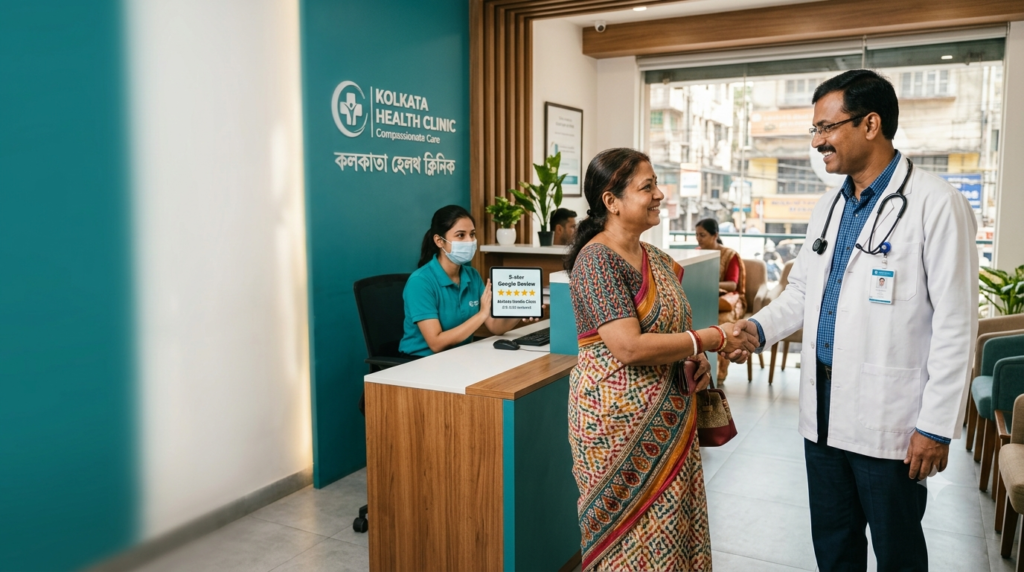
- Collect reviews systematically, not desperately. The clinics winning in Kolkata right now ask every satisfied patient at the billing desk — a simple QR code standee works wonders. Aim for a steady trickle (4–8 reviews a month) rather than a suspicious burst of 50.
- Reply to every review. Yes, even the unfair ones. A calm, professional reply to an angry review builds more trust with future patients than ten five-star ratings. Never discuss the patient’s medical details in your reply — that’s both unethical and a legal risk.
- Post weekly. Health camps, new doctor joinings, festive timings during Durga Puja — GBP posts keep your profile active, and Google rewards active profiles.
This costs almost nothing except discipline. It’s the highest-ROI activity in all of healthcare digital marketing in Kolkata, and most of your competitors are doing it badly.
Step 2: Build a Website That Reassures, Not Just Exists
Your website has one job: convince a nervous, researching patient that you’re the safe choice. Everything on it should serve that goal.
What patients actually look for (in order):
- Doctor credentials and faces. Real photos, qualifications, years of experience, where they trained. A doctor page with a genuine photo and a two-line human bio converts far better than a stock-image “Our Team” page.
- What conditions you treat, in plain language. Not “advanced laparoscopic interventions” — say “gallbladder stone surgery” because that’s what patients search and understand.
- How to reach you. Click-to-call button, WhatsApp button, embedded map, and visiting hours — visible without scrolling on mobile. Over 80% of your healthcare traffic in Kolkata will be on a phone.
- Proof. Reviews, patient counts, years in practice, accreditations (NABH, NABL if you have them). Testimonials with first names and localities (“Suparna D., Kasba”) feel real; anonymous ones feel fabricated.
Technical basics that quietly kill practices: a site that takes six seconds to load on Jio 4G, forms that don’t work, an SSL certificate that expired. Fix these before spending a rupee on ads.
And one thing specific to healthcare: add a page for each doctor and each major treatment. “Dr. [Name] – Cardiologist in Kolkata” and “Angioplasty in Kolkata – Cost, Procedure & Recovery” are the pages that rank and convert. A single homepage trying to do everything ranks for nothing.
Step 3: Local SEO — Winning the “Near Me” War

Search engine optimisation for healthcare in Kolkata is overwhelmingly local SEO. Here’s the practical playbook:
Target locality + specialty keywords. Your patients search the way they speak: “gynecologist in Behala”, “best dental clinic New Town”, “24 hour pharmacy Tollygunge”. Build individual pages or blog posts around these — one page per specialty per major locality you serve. Don’t stuff ten localities on one page; Google sees through it and patients find it spammy.
Answer the questions patients actually ask. A blog isn’t decoration; it’s how you capture patients earlier in their journey. Posts like:
- “Cataract surgery cost in Kolkata: what’s included and what’s not”
- “When should you take your child to a paediatric neurologist?”
- “Dengue season in Kolkata: warning signs that need a hospital visit”
These build topical authority, earn trust before the patient ever calls, and increasingly get quoted by AI assistants like ChatGPT and Google’s AI Overviews — which is where a growing slice of health research now happens. Structured, factual, clearly-written answers are what get cited there.
Get listed where patients look. Practo, Justdial, Lybrate, and local directories. Keep your name, address, and phone number identical everywhere — inconsistent listings confuse Google and dilute your local rankings.
Add medical schema markup. This is code that tells Google “this is a physician, this is the specialty, these are the hours.” It’s invisible to patients but helps you earn rich results — star ratings and details right on the search page.
Step 4: Content That Builds Authority (Without Breaking Ethics)
Healthcare content walks a line. The MCI/NMC ethics code restricts direct solicitation and superlative claims — you can’t run ads screaming “Best cardiologist in Kolkata, guaranteed cure!” And honestly, you shouldn’t want to; it destroys the very trust you’re trying to build.
What you can do, powerfully:
- Educate. Explain conditions, procedures, recovery timelines, and costs honestly. The clinic that publishes “What to expect during your first IVF consultation” wins the patient who reads it.
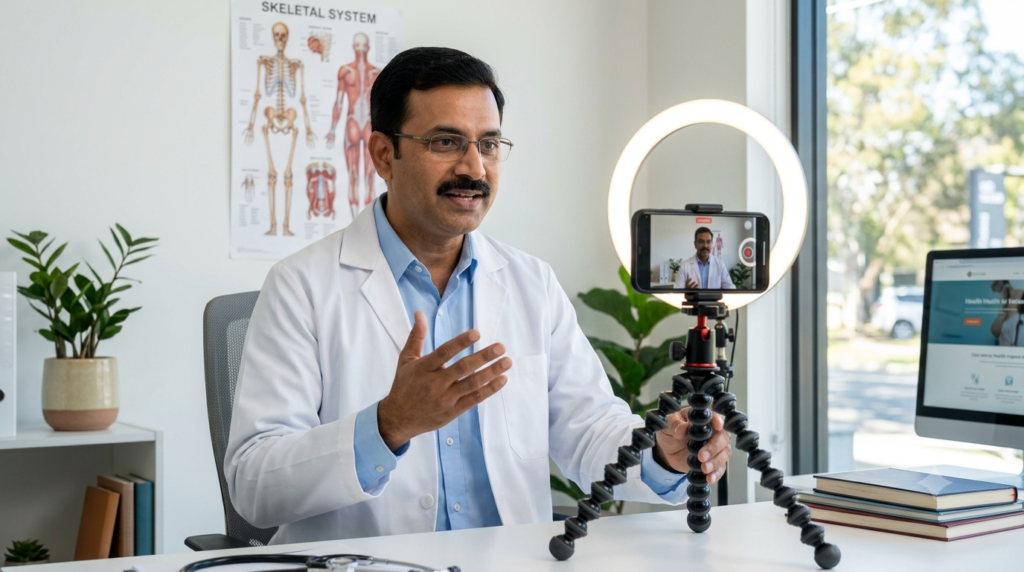
- Show, don’t claim. Facility walkthrough videos, doctor interviews explaining a common condition in Bengali and English, day-in-the-life reels of your physiotherapy centre. Video humanises medicine, and Kolkata audiences respond strongly to doctors who speak their language — literally.
- Use patient stories carefully. Written consent, no identifying medical details, focus on the journey and the care experience rather than miraculous outcomes.
A cardiologist we’ve observed doing this well posts one short Bengali-language explainer video a week — nothing fancy, shot on a phone in his chamber. His appointment requests from Instagram and YouTube now rival his referral walk-ins. Consistency beat production value.
Step 5: Paid Ads — Where They Fit (And Where They Waste Money)
Google Ads and Meta ads work for healthcare in Kolkata, but only after the foundation above is solid. A few hard-earned rules:
Google Search ads work best for high-intent, urgent, or comparison-heavy services: dental implants, IVF, LASIK, health check-up packages, physiotherapy. Bid on “service + Kolkata/locality” terms. Send clicks to a dedicated landing page with a call button and a form — never your homepage.
Meta (Facebook/Instagram) ads work for awareness and camps: free diabetes screening in your locality, a new branch opening, a visiting super-specialist. Kolkata’s Facebook usage skews older than most metros — which happens to match many healthcare audiences perfectly.
Know the compliance rules. Google restricts certain healthcare ad categories and personalised targeting for health conditions. A good agency navigates this; a careless one gets your ad account suspended.
Track calls, not clicks. The metric that matters is appointments booked, not impressions. If your marketing partner reports “reach” and “engagement” but can’t tell you how many patient calls came in, that’s a red flag.
Step 6: Reputation Management — Your 24/7 Front Desk
One genuinely bad review handled badly costs more than ten handled well. Set up a simple system:
- Monitor Google, Practo, and Facebook mentions weekly.
- Respond to negatives within 24–48 hours: acknowledge, apologise for the experience (not admit fault), and move the conversation offline. “We’re sorry your visit didn’t meet expectations — please call our patient care desk at [number] so we can understand what happened.”
- Bury the occasional negative under a steady stream of genuine positives (see Step 1).
- Never buy fake reviews. Kolkata is a small city in the ways that matter — patients spot fakes, and Google’s filters increasingly catch them.
What Results Actually Look Like (Realistic Timelines)

Anyone promising you “page 1 in 30 days” is selling you a story. Here’s an honest timeline based on what healthcare practices in Kolkata typically experience:
- Month 1–2: GBP optimised, website fixed, review system running. Calls from Maps start improving — often the first visible win.
- Month 3–4: Locality + specialty pages begin ranking for long-tail searches. Ad campaigns (if running) reach stable cost-per-appointment numbers.
- Month 6+: Compounding kicks in. Content ranks, reviews accumulate, brand searches for your clinic name rise. This is where digital stops being an expense and becomes an asset — one that keeps working while you’re in the OT.
Digital marketing for healthcare is a marathon with checkpoints, not a lottery ticket.
Common Mistakes We See Kolkata Clinics Make
- Spending on ads before fixing the Google Business Profile and website
- One generic website page instead of dedicated doctor and treatment pages
- Ignoring Bengali-language search entirely
- Buying a bulk “SEO package” from an agency that also sells to restaurants, gyms, and salons — healthcare has its own rules, ethics, and patient psychology
- Treating reviews as vanity instead of the primary trust signal they are
- Giving up at month two, right before results typically appear
Frequently Asked Questions
How much does healthcare digital marketing cost in Kolkata? A solo practitioner can start meaningfully at ₹15,000–30,000/month (GBP management, local SEO, review systems). Multi-specialty clinics and hospitals typically invest ₹50,000–2,00,000+/month once paid ads and content production are added. The right number depends on your specialty’s competition — IVF and dental are far more contested than, say, nephrology.
Is digital marketing allowed for doctors in India? Yes — educating patients, maintaining a website, listing services, and running compliant ads are all permitted. What’s restricted is direct solicitation, superlative claims (“No.1”, “guaranteed cure”), and misleading testimonials. An experienced healthcare marketing partner keeps you on the right side of NMC guidelines.
How long before I see more patients? Google Business Profile improvements often show within 4–8 weeks. SEO takes 3–6 months to compound. Paid ads can generate enquiries within days — but convert well only if your profile, reviews, and landing pages are in shape first.
Should I do this myself or hire an agency? The basics — reviews, GBP posts, responding to patients — you or your front-desk team can absolutely own. SEO, ad compliance, content strategy, and technical work usually justify a specialist partner, ideally one with local Kolkata market experience and healthcare-specific work in their portfolio.
The Bottom Line
The surgeon from Gariahat I mentioned at the start? Six months after fixing his fundamentals — a proper Google profile, a review system at his billing desk, one Bengali explainer video a week, and three locality pages — his new-patient enquiries were up noticeably, and more importantly, the kind of patient changed: people arrived already trusting him, having read his content.
That’s the real promise of healthcare digital marketing in Kolkata. Not gimmicks. Not vanity metrics. A digital presence that does what your reputation always did — earn trust — just faster, wider, and around the clock.
If you’d like an honest look at where your practice stands online — what’s working, what’s leaking patients, and what to fix first — we offer a free digital health check for Kolkata doctors, clinics, and hospitals. No pressure, no jargon. Just a clear picture and a practical plan.
Want an experienced team to set it up right the first time?
We understand the Kolkata market — its neighbourhoods, its customers, its price points. Let's have a no-pressure conversation about what we can do for your business.

Performance marketing team · Kolkata Digital Marketing Company