
AI in Digital Marketing: What It Means for Kolkata Businesses in 2026
 AI & Technology
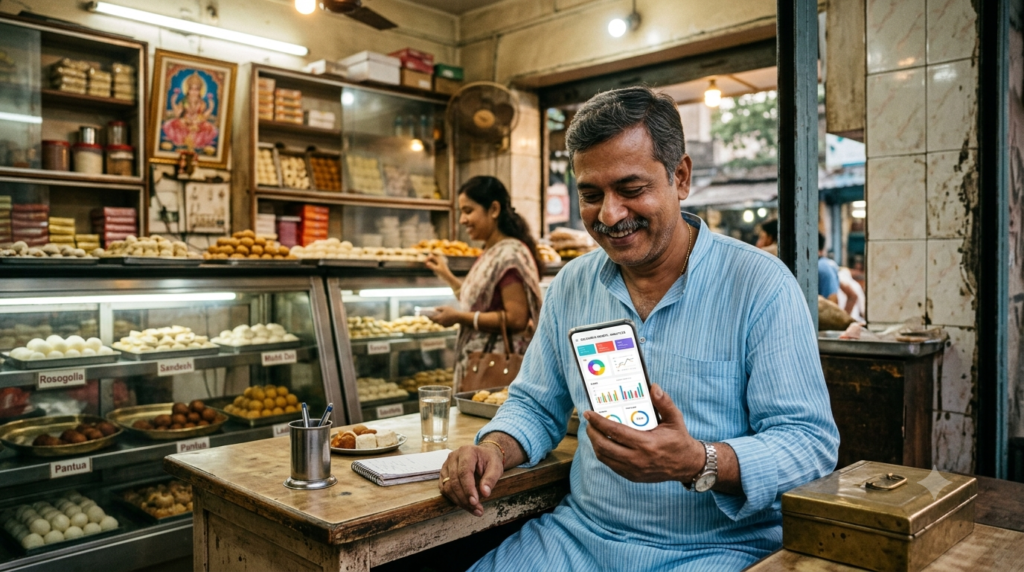
 Last month, I sat across from a sweet shop owner in Bhowanipore who has been running his family business for over thirty years. He slid his phone across the table and asked me a question I’ve been hearing a lot lately: “Everyone keeps telling me AI will do my marketing. Is that true, or is it just another thing people are selling?”
It’s a fair question. And the honest answer is somewhere in the middle.
AI digital marketing in Kolkata in 2026 is no longer a buzzword thrown around at conferences in Salt Lake Sector V. It’s already deciding which of your ads people see, what price you pay per click, and whether your shop shows up when someone nearby searches “best kachori near me.” The businesses that understand this — even at a basic level — are quietly pulling ahead. The ones ignoring it are paying more for less.
This guide breaks down what’s actually happening, what it means for a business like yours, and what you can realistically do about it — without jargon, and without pretending you need a Silicon Valley budget.
What Do We Actually Mean by “AI in Digital Marketing”?
Let’s clear this up first, because the term gets stretched to cover everything from robots to spam emails.
When marketers talk about AI in 2026, they usually mean a handful of practical technologies:
Machine learning in ad platforms. Google Ads and Meta Ads no longer just follow your targeting instructions. Their systems study millions of signals — time of day, device, past behaviour, location — and decide who is most likely to buy from you. When you run a campaign today, you’re essentially co-piloting with an algorithm.
Generative AI for content. Tools like ChatGPT, Gemini, and Claude can draft blog posts, ad copy, product descriptions, and social media captions in seconds. In Bengali and Hindi too, not just English — which matters enormously in a city where your customer might search in three languages in one day.
Predictive analytics. Software that looks at your past sales and customer data and predicts what happens next: which customers are about to stop buying, which products will spike during Durga Puja, which leads are worth calling first.
Chatbots and conversational AI. The WhatsApp auto-replies and website chat windows that answer customer questions at 2 a.m. when your staff is asleep.
AI-driven search. This is the big one most people miss. Google now shows AI-generated answers (AI Overviews) at the top of many searches, and a growing number of people ask ChatGPT or Perplexity for recommendations instead of Googling at all. How your business appears — or doesn’t — in those AI answers is becoming a new battleground.
None of these replaces a marketing strategy. They change how fast and how cheaply you can execute one.
Why 2026 Is Different for Kolkata Specifically
You might be thinking: this all sounds like Bangalore and Gurgaon talk. Why should a business in Gariahat or Howrah care?
Three reasons, and they’re all local.
1. Your customers changed before you did
Kolkata’s internet users have quietly become some of the most voice-search-heavy and vernacular-search-heavy users in the country. People search in Bengali. They ask their phones full questions instead of typing keywords. They watch Reels to decide where to eat before they check a menu.
AI systems handle this messy, conversational, multilingual behaviour far better than old keyword-based marketing ever did. If your digital presence was built for the “typed English keyword” era, you’re already invisible to a chunk of your own neighbourhood.
2. Competition got cheaper for everyone — including your rivals

Here’s the uncomfortable truth: the tea stall chain down the road can now produce a month of decent social media content in an afternoon using free AI tools. The boutique in New Market can run algorithm-optimised ads with a ₹5,000 budget that would have needed an agency retainer five years ago.
AI has lowered the floor. That’s great news if you use it. It’s terrible news if you don’t, because the gap between “doing nothing” and “doing the basics” now shows up in weeks, not years.
3. Kolkata’s business fabric is exactly what AI marketing serves best
This city runs on small and mid-sized businesses — family-owned retailers, coaching centres, restaurants, healthcare clinics, real estate firms, manufacturers in the industrial belt stretching out towards Durgapur and Asansol. These are precisely the businesses that never had the budget for data analysts and full creative teams. AI tools are, in effect, a rented marketing department that costs less than one employee’s salary.
Where AI Is Already Making a Difference (With Local Examples)
Theory is boring. Here’s what this actually looks like on the ground, based on patterns we see working with businesses across the city.
Hyper-local advertising that finally makes sense
A restaurant in Salt Lake doesn’t need to advertise to all of Kolkata. AI-powered ad platforms can now focus spend on people within a 3 km radius who have shown food-ordering behaviour, at the hours they typically order, in the language they browse in. The result isn’t magic — it’s simply less wasted money. We routinely see cost-per-lead drop by 30–50% when campaigns move from broad manual targeting to AI-assisted local targeting done properly.
Content in Bengali, Hindi, and English — without tripling your workload
A coaching centre in Dum Dum can draft its exam-season campaign once and use AI to adapt it fluently across three languages, then have a human polish the tone. Two years ago this meant hiring translators or publishing in English only and losing the parents who search in Bengali. That barrier is essentially gone.
WhatsApp automation that doesn’t feel robotic
For most Kolkata businesses, WhatsApp is the sales channel. AI-powered WhatsApp flows now handle the repetitive 80% — “Are you open?”, “What’s the price?”, “Do you deliver to Behala?” — and hand over to a human the moment a real conversation starts. Clinics use it for appointment booking. Retailers use it for order updates. The businesses doing this well respond in seconds while competitors respond the next morning.
Festive-season forecasting

Durga Puja isn’t just a festival here; it’s a fiscal quarter. Predictive tools can look at your last two or three years of sales and tell you which products to stock, when to start ads, and how much daily budget the Puja week deserves versus Poila Boishakh or the wedding season. Gut feeling still matters — but gut feeling plus data beats gut feeling alone.
Showing up in AI answers, not just search results
When someone asks ChatGPT or Google’s AI Overview “best interior designer in South Kolkata,” those systems pull from structured, trustworthy, well-organised web content. Businesses with clear service pages, genuine reviews, consistent listings, and FAQ-style content get cited. Businesses with a five-year-old static website do not. This is the new local SEO, and most of the city hasn’t noticed yet.
The Honest Downsides (Because There Are Some)
I’d be doing you a disservice if I only sold the upside. A few real warnings:
AI content can make you sound like everyone else. If you and your three competitors all ask the same tool to “write a Facebook post for a saree shop,” you’ll get four nearly identical posts. AI drafts; humans differentiate. The businesses winning with AI content use it for speed, then inject their own stories, photos, humour, and voice. Your thirty years in Bhowanipore is your advantage — no algorithm has that.
Bad data means bad predictions. If your sales records live in a khata and half your customer numbers are missing digits, predictive analytics can’t help you yet. Basic digital hygiene comes first.
Privacy rules are tightening. India’s data protection framework means you can’t just scrape and blast customer data anymore. Consent-based marketing — people opting in to your WhatsApp list, for example — isn’t only ethical; it’s now the legally safe route.
AI doesn’t fix a bad offering. No amount of algorithmic targeting will save a business whose product, pricing, or service is the actual problem. Marketing amplifies what exists. AI just amplifies it faster.
A Practical Roadmap for Kolkata Businesses in 2026

You don’t need to do everything. Here’s a realistic sequence, from easiest to most ambitious.
Stage 1: Foundations (Month 1 — costs almost nothing)
Get your Google Business Profile complete and active — photos, hours, services, and replies to every review. This single free asset feeds both traditional local search and AI-generated answers. Then set up a WhatsApp Business account with a proper catalogue and quick replies. Finally, start using a free AI tool to draft (not finish) your social media content, and post consistently in the languages your customers actually use.
Stage 2: Smarter spending (Months 2–4)
Move your ad campaigns to AI-assisted formats — Performance Max on Google, Advantage+ on Meta — but feed them good inputs: real photos, honest offers, tight local targeting. Add basic conversion tracking so the algorithms learn from actual enquiries, not just clicks. This is the point where many businesses benefit from working with a professional digital marketing team, because AI ad platforms reward good setup and quietly punish sloppy setup with wasted budget.
Stage 3: Owning your data (Months 4–8)
Start collecting customer information properly — a simple CRM, even a well-structured spreadsheet to begin with. Segment customers: regulars, festival-only buyers, lapsed customers. Use AI-assisted email and WhatsApp campaigns tailored to each group. This is where the compounding begins: your marketing gets cheaper every month because you’re increasingly talking to people who already know you.
Stage 4: Competing for AI visibility (Ongoing)
Build content that answers the real questions your customers ask — pricing pages, FAQs, comparison guides, genuinely useful blog posts. Keep your listings and reviews healthy. Structure your website so AI systems can understand what you do, where you are, and why you’re credible. This is slow work, but it’s how a Kolkata business gets recommended by a chatbot to someone who never even opened Google.
What Should You Budget?
Rough, honest numbers for a small-to-mid Kolkata business in 2026:
The free tier — Google Business Profile, WhatsApp Business, free AI writing tools, organic social media — costs only your time and can genuinely move the needle for a hyperlocal business. A modest paid setup — ₹10,000–₹30,000 monthly in ad spend plus tools — suits most retailers, clinics, and service businesses testing seriously. Growth-stage businesses combining ads, content, automation, and professional management typically invest ₹50,000 upwards per month, and at that level the question isn’t cost but return: campaigns should be measured against enquiries and revenue, not likes.
The most expensive option, as always, is doing nothing while your competitors’ cost of reaching your customers keeps falling.
Frequently Asked Questions
Will AI replace digital marketing agencies in Kolkata? No — but it’s replacing agencies that only did mechanical work. The value has shifted to strategy, local market understanding, creative judgement, and knowing how to make AI tools perform. Execution got cheaper; thinking got more valuable.
Can AI marketing work for a purely offline business? Yes, and often best. If your customers walk through a door in Ballygunge, hyper-local AI targeting, Google Business optimisation, and WhatsApp automation are among the highest-ROI things you can do — they exist precisely to turn online attention into footfall.
Do AI tools work in Bengali? Increasingly well. The major AI models handle Bengali content drafting competently in 2026, though a human review for tone and cultural nuance is still strongly recommended. For a Kolkata audience, Bengali-language content is an underused advantage, not an afterthought.
Is AI marketing safe for customer data? It can be, if you use reputable tools and collect data with consent. Avoid uploading sensitive customer details into random free tools, and follow opt-in practices for WhatsApp and email lists.
How long before I see results? Ad campaigns: enquiries within days, optimised performance within 4–8 weeks as the algorithms learn. SEO and AI-search visibility: typically 3–6 months of consistent work. Anyone promising page-one rankings in a week is selling you something other than marketing.
The Bottom Line
Back to that sweet shop owner in Bhowanipore. Here’s what I told him: AI won’t run your marketing for you, but it has made good marketing affordable for businesses your size for the first time. The technology is no longer the barrier. The barrier is simply starting.
Kolkata has never lacked entrepreneurial spirit — this city built businesses through every disruption of the last century. AI in digital marketing is just the newest one, and unlike many previous shifts, this one actually favours the small, local, and genuine.
If you’d like help figuring out where AI fits into your marketing — whether that’s a first audit, smarter ad campaigns, or a full strategy — our team works with Kolkata businesses every day and speaks your language, in every sense. Reach out for a free consultation, and let’s build something that works in this city, for this city.
Want an experienced team to set it up right the first time?
We understand the Kolkata market — its neighbourhoods, its customers, its price points. Let's have a no-pressure conversation about what we can do for your business.

Performance marketing team · Kolkata Digital Marketing Company