
What Is On-Page SEO? A Plain-Language Guide for Kolkata Business Owners
 Digital Marketing Basics
 Last month, a sweet shop owner from Bhowanipore asked me a question I hear all the time: “Dada, my website looks beautiful, my mishti is the best in the para — so why does Google show my competitor first when someone searches for sweets near me?”
The honest answer? His website was a lovely brochure that Google couldn’t properly read. His competitor’s site, while plainer to look at, was speaking Google’s language fluently.
That language is called on-page SEO — and this on-page SEO guide for Kolkata business owners will teach you to speak it, without a single line of code and without drowning you in jargon.
Whether you run a boutique in Gariahat, a CA firm in Salt Lake, a restaurant in Park Street, or a manufacturing unit in Howrah, everything below applies to you. Let’s begin.
What Exactly Is On-Page SEO?
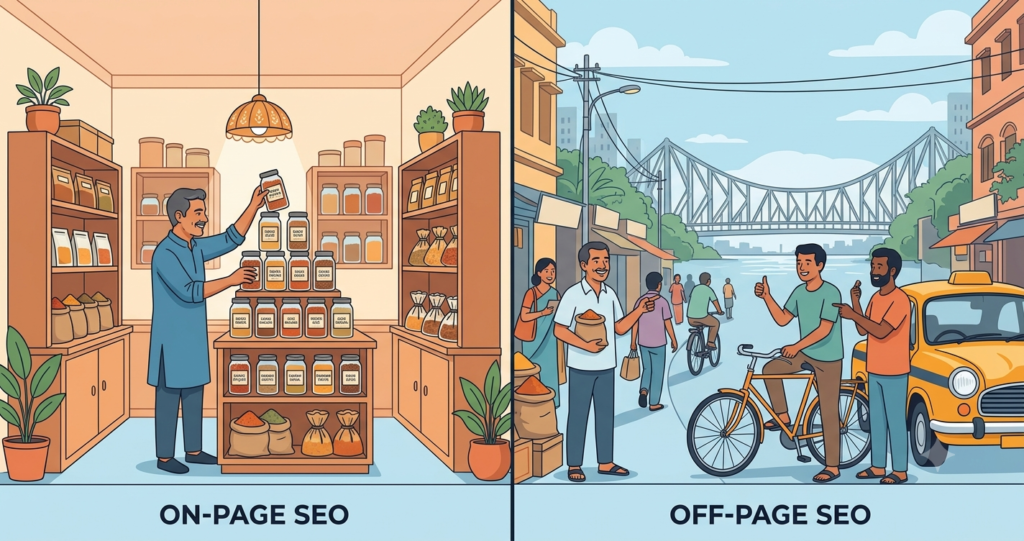
On-page SEO means everything you do on your own website to help it rank higher on Google.
Think of it this way. SEO has two halves:
- On-page SEO — things you control directly: your page titles, headings, content, images, and internal links. Like decorating and organising your own shop.
- Off-page SEO — things that happen elsewhere: other websites linking to you, reviews, mentions. Like your reputation in the market.
You can’t force someone to recommend your shop. But you can absolutely control how your shop looks, how it’s organised, and whether the signboard clearly says what you sell. That’s on-page SEO — the part entirely in your hands, starting today, for free.
Why Should a Kolkata Business Owner Care?
Because your customers have moved online, even if your business hasn’t fully.
Before visiting a shop in Hatibagan or booking a dentist in New Alipore, people now search first. “Best biryani in Ballygunge.” “CA for GST filing Salt Lake.” “Saree shop near Gariahat metro.” If your website doesn’t show up for these searches, you’re invisible to a customer who was actively looking for exactly what you sell.
And here’s the part most local business owners miss: your competition on Google is usually weak. Most Kolkata small business websites were built once, years ago, and never touched again. A few honest hours of on-page SEO work often lifts a local site past competitors who’ve done nothing. In competitive markets like Delhi or Bangalore, that’s harder. In many Kolkata niches, the door is still wide open.
The 8 Building Blocks of On-Page SEO (Explained Like You’re Talking to a Friend)
1. The Title Tag — Your Shop’s Signboard on Google
The title tag is the blue clickable headline people see on Google’s results page. It’s the single most important on-page element, and it’s the one most local websites get wrong.
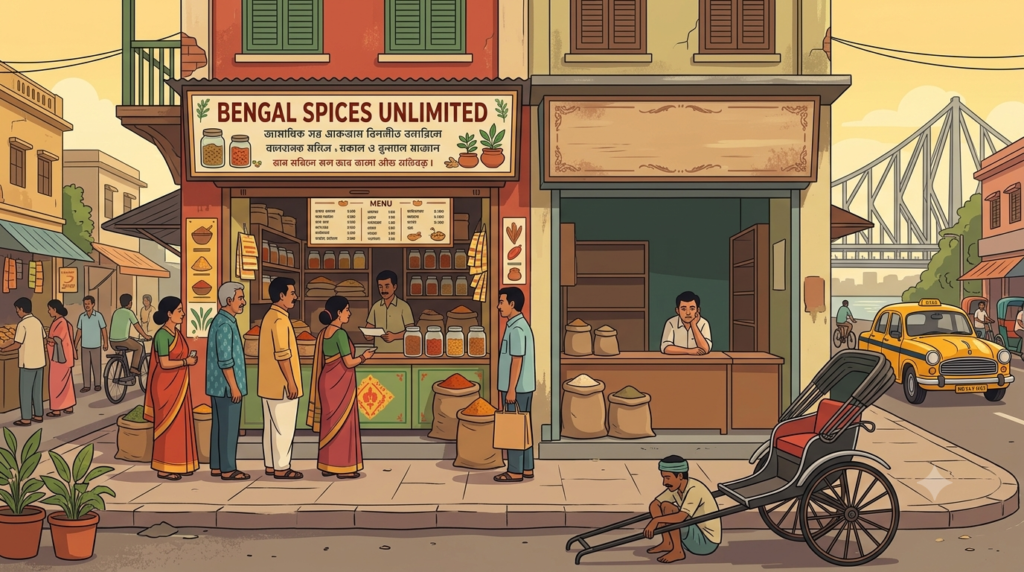
Walk down any street in Burrabazar and you’ll see shops with clear signboards: what they sell, sometimes since when. Now imagine a shop whose board just says “Welcome.” That’s what most business websites do — their homepage title reads “Home” or just the company name.
What a weak title looks like:
Home | Sharma Enterprises
What a strong title looks like:
Wholesale Paper Suppliers in Burrabazar, Kolkata | Sharma Enterprises
The second version tells Google and the searcher exactly what you do and where. Keep it roughly 50–60 characters, put your main keyword near the beginning, and give every page on your site its own unique title.
2. The Meta Description — Your Two-Line Sales Pitch
Under the blue title on Google sits a short grey snippet of text. That’s your meta description. It doesn’t directly boost rankings, but it heavily influences whether people click your result instead of your competitor’s — and clicks matter.
Write it like you’d pitch a customer standing at your counter: what you offer, why you’re worth choosing, and what to do next. Aim for 120–160 characters.
Weak: “We are a leading company providing quality services to our clients.”
Strong: “Handloom sarees from Shantipur & Dhaniakhali, delivered across Kolkata in 2 days. Visit our Gariahat store or order on WhatsApp.”
Notice the second one mentions real places, real products, and a real action. Specificity earns clicks.
3. Headings — The Structure of Your Page
Headings (H1, H2, H3 in web terms) are the bold section titles on your page. They work like the sections of a newspaper — imagine reading the Telegraph or Anandabazar with no headlines, just one endless wall of text. You’d give up. So does Google.
Simple rules:
- Every page gets exactly one H1 — the main headline — and it should contain your main keyword. For a bakery page: “Fresh Cakes and Pastries in Jadavpur” beats “Welcome to Our Website.”
- Use H2s to break the page into logical sections, the way this article does.
- Make headings descriptive. “Our Catering Packages for Weddings in Kolkata” tells Google something. “Our Services” tells it nothing.
4. Keywords — Use the Words Your Customers Actually Type
A keyword is simply whatever your customer types into Google. And here’s a mistake I see constantly in Kolkata: businesses write their websites in their language instead of the customer’s language.
A clinic writes “comprehensive dermatological solutions.” The patient searches “skin doctor in Behala.” Guess which phrase needs to be on the page?
How to use keywords sensibly:
- Pick one main keyword per page (e.g., “interior designer in Salt Lake” for your Salt Lake service page).
- Place it in your title tag, your H1, and naturally within the first paragraph.
- Then write like a human. Sprinkle in related terms — for that interior designer, phrases like “flat renovation,” “modular kitchen,” “2BHK interior cost Kolkata” — because Google understands topics, not just exact word matches.
One warning: don’t stuff. Repeating “best saree shop Kolkata best saree shop Kolkata” ten times reads like spam to your visitors and to Google. If a sentence sounds unnatural read aloud, rewrite it.
5. Content Quality — The Real Ranking Engine
Here’s an uncomfortable truth: no amount of technical polish will rank a page that says nothing useful. Google’s entire business depends on showing people genuinely helpful results, and its systems have become remarkably good at recognising thin, copied, or empty content.
What helpful content looks like for a local business:
- Answer real questions. A Tollygunge tuition centre could write “How to choose between WBCHSE and CBSE coaching” — a question local parents genuinely search.
- Show first-hand experience. Photos of your actual shop, your actual work, your actual team. A caterer showing real wedding spreads at a Kolkata banquet hall beats stock photos of foreign buffets every time.
- Be specific to your area. Mention the neighbourhoods you serve, landmarks near you (“2 minutes from Rabindra Sarobar metro”), delivery zones, local pricing. This is gold for local searches, and outsiders can’t fake it.
- Go deeper than competitors. If every plumber’s website in your area is one thin page, a proper page explaining your services, rates, response times, and covered areas will stand out sharply.
Aim for pages that would genuinely help a customer even if Google didn’t exist. That mindset alone puts you ahead of most local competition.
6. Images — Make Google “See” Your Photos
Google can’t look at a photo the way we can. It reads the text attached to it. Two small habits fix this:
- Rename files before uploading. IMG_20260114.jpg means nothing. rosogolla-box-kolkata-sweet-shop.jpg tells Google exactly what’s in the picture.
- Add alt text — a one-line description of each image, which every website builder (WordPress, Wix, Shopify) lets you add. Write it plainly: “terracotta jewellery handmade in Bishnupur” — descriptive first, keyword only if it fits naturally.
Also compress your images. Heavy photos are the number one reason local websites load slowly, and slow sites lose both rankings and impatient mobile visitors — which in Kolkata, on a shaky 4G connection during monsoon, is basically everyone.
7. URLs — Keep Your Web Addresses Clean
Your URL is the address of each page. Compare:
- yoursite.com/page?id=847&cat=3 ❌
- yoursite.com/bridal-makeup-kolkata/ ✅
Short, lowercase, hyphen-separated, and containing the page’s keyword. That’s the whole rule. One caution: once a page is published and getting visitors, avoid changing its URL — it’s like shifting your shop without telling anyone the new address.
8. Internal Links — Guide Visitors Around Your Site
Internal links are simply links from one page of your website to another. They matter more than they seem.
When your “About” page links to your “Wedding Photography Packages” page using those actual words (not just “click here”), two things happen: visitors find related pages easily, and Google understands how your site fits together and which pages matter most.
Easy habit: every time you publish something new, link to it from two or three older relevant pages, and link from the new page back to your key service pages. Think of it as putting up signboards inside your own shop pointing customers to different counters.
A Special Note for Kolkata: The Local SEO Layer
Everything above applies to any website on earth. But as a local business, you have one extra advantage to press: local relevance.
- Put your full address, phone number, and areas served clearly on your website — ideally in the footer of every page.
- Create separate pages for separate localities if you genuinely serve them differently. A tutor covering both Salt Lake and Behala can have a page for each, with locality-specific detail — not the same page copied with the neighbourhood name swapped.
- Match your website’s business name, address, and phone number exactly with your Google Business Profile listing. Consistency builds Google’s confidence in showing you for “near me” searches.
- Consider your audience’s language. If your customers search in Bengali, content in Bengali (or bilingual pages) can capture searches your English-only competitors completely miss. “কলকাতায় সেরা মিষ্টির দোকান” is a search someone is making right now.
Your First-Week On-Page SEO Checklist

You don’t need to do everything at once. Here’s a realistic sequence:
- Day 1: Rewrite your homepage title tag and meta description with your main keyword + “Kolkata” or your locality.
- Day 2: Check every page has one clear H1 containing that page’s keyword.
- Day 3: Rewrite your most important service page in plain customer language, answering the questions buyers actually ask.
- Day 4: Rename and compress your images; add alt text to the important ones.
- Day 5: Add internal links between your related pages.
- Day 6: Add your address, phone, and service areas to the footer.
- Day 7: Open your site on a mobile phone and honestly ask: would I trust this business? Fix what feels off.
None of this needs a developer. Most of it is thoughtful writing.
Common Questions Kolkata Business Owners Ask
How long before I see results? On-page fixes typically start showing movement in 4–12 weeks for local keywords. SEO is a habit, not a switch — but local competition in Kolkata is often soft enough that well-optimised pages climb faster than you’d expect.
Do I need to pay Google to rank? No. Google Ads and organic rankings are separate. On-page SEO improves your free, organic visibility — the results people actually trust more.
My website is on Wix/WordPress/Shopify. Does this still apply? Yes, fully. Every major platform lets you edit titles, descriptions, headings, alt text, and URLs. The platform doesn’t rank you; what you write does.
Should I do this myself or hire someone? Start yourself — this guide covers the fundamentals honestly. If your industry is competitive (real estate, healthcare, education in Kolkata are heating up), a professional team can layer on keyword research, content strategy, and technical SEO that compounds your results.
The Bottom Line
On-page SEO isn’t a dark art. It’s the digital version of things every good Kolkata businessman already understands: a clear signboard, an organised shop, honest answers to customer questions, and being easy to find in your para.
Your website should do online what your best salesperson does at the counter — understand what the customer is looking for and answer it plainly. Do that consistently across your pages, and Google will notice. More importantly, your customers will.
Start with your title tags this week. Small fixes, done properly, compound — and in a city where most of your competitors haven’t touched their websites in years, being the one who does is a genuine advantage.
Need help putting this into practice? Our team at Kolkata Digital Marketing Company works with local businesses every day — from Burrabazar wholesalers to Salt Lake startups. Reach out for a free on-page SEO review of your website.
Want an experienced team to set it up right the first time?
We understand the Kolkata market — its neighbourhoods, its customers, its price points. Let's have a no-pressure conversation about what we can do for your business.

Performance marketing team · Kolkata Digital Marketing Company