
Digital Marketing for Restaurants in Kolkata: Get More Orders Online
 Digital Marketing
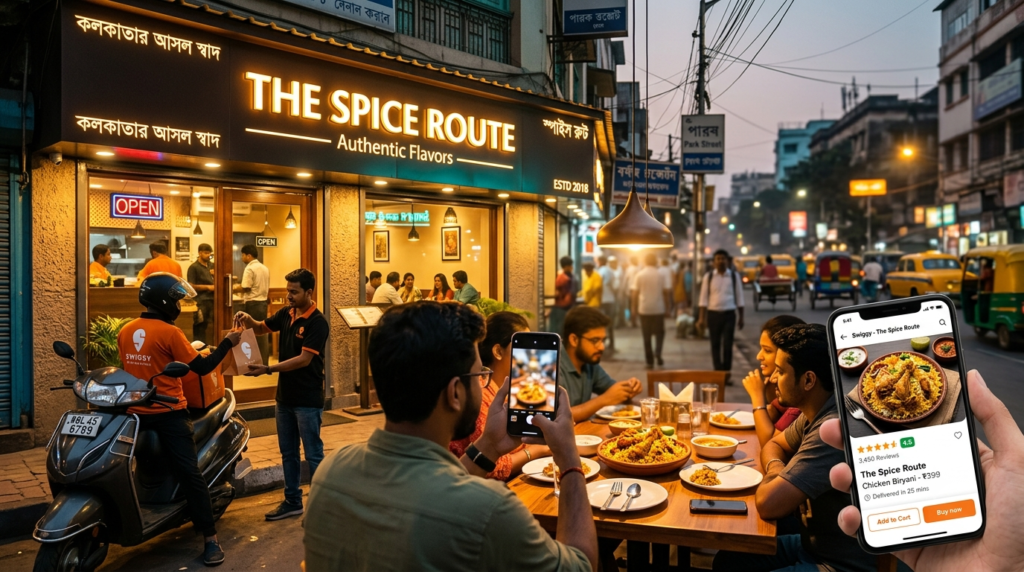
 Walk down any lane in Park Street, Salt Lake, or Gariahat on a Friday evening, and you’ll see it — restaurants packed with people, delivery riders zipping in and out, phones buzzing with orders. But here’s the uncomfortable truth: for every restaurant thriving in Kolkata right now, there are three others with empty tables and a Zomato listing nobody scrolls past.
The difference? It’s rarely the food. Kolkata has never had a shortage of great kitchens. The difference is visibility. And in 2026, visibility means one thing — showing up online where your hungry customers are already looking.
That’s exactly what this guide is about. If you run a restaurant, cloud kitchen, café, or catering business in Kolkata, this article will walk you through how digital marketing for restaurants in Kolkata actually works — not in vague theory, but in practical steps you can start applying this week.
Why Kolkata Restaurants Can’t Ignore Digital Marketing Anymore
Let’s start with a simple exercise. Open your phone and type “biryani near me” into Google. Notice what shows up first — a map with three restaurant listings, star ratings, photos, and a “Order Online” button.
Now ask yourself honestly: is your restaurant one of those three?
If not, you’re invisible during the exact moment a customer is ready to spend money. That customer isn’t going to scroll to page two of Google. They’ll order from whoever shows up first, looks trustworthy, and makes ordering easy.
Here’s what has changed about how Kolkata eats:
- People search before they eat. Whether it’s a family in Behala planning a Sunday lunch or an office group in Sector V ordering rolls, the journey almost always starts with a Google search, an Instagram scroll, or a food delivery app.
- Reviews decide reputations. A 3.8-star rating versus a 4.4-star rating can mean a 30–40% difference in orders. Customers trust strangers’ reviews more than your own menu descriptions.
- Delivery apps are crowded. Zomato and Swiggy have thousands of listings in Kolkata alone. Without smart positioning, your restaurant is a needle in a haystack.
- Word of mouth has gone digital. That aunty who used to recommend your kosha mangsho to her neighbours? Her recommendation now happens in a WhatsApp group or a Facebook food community like “Calcutta Foodies Club.”
Digital marketing isn’t an optional add-on for restaurants anymore. It’s the new shopfront.
The 7 Pillars of Restaurant Digital Marketing in Kolkata
Over the years of working with food businesses across the city — from heritage eateries in North Kolkata to new-age cloud kitchens in New Town — we’ve seen that successful restaurant marketing always rests on the same seven pillars. Let’s go through each one.
1. Google Business Profile: Your Most Powerful Free Tool
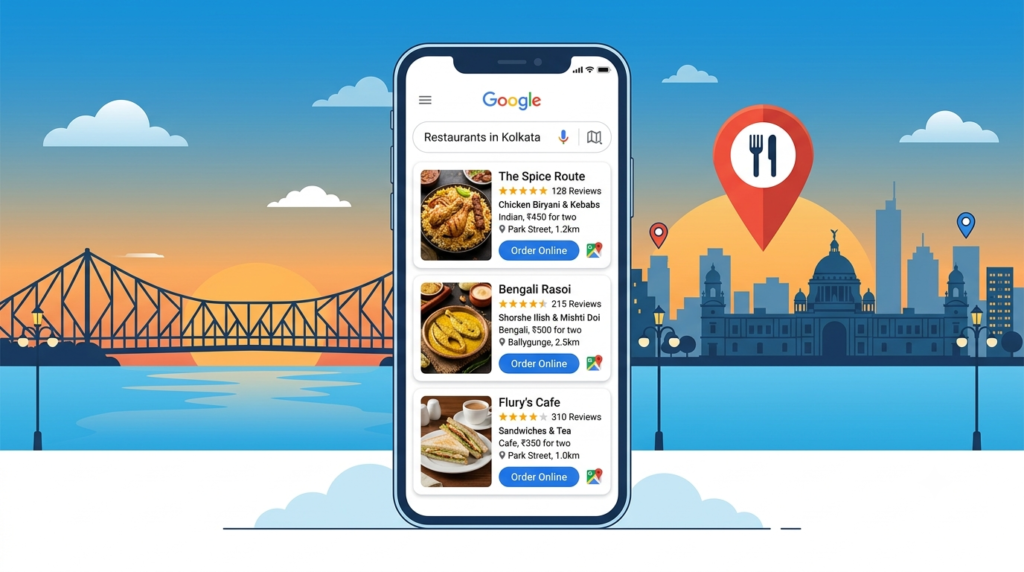
If you do only one thing after reading this article, do this: claim and fully optimise your Google Business Profile (formerly Google My Business).
When someone searches “best Chinese restaurant in Tangra” or “cafés near Southern Avenue,” Google shows the local map pack first — before any website. Getting into that top-three map pack can transform your walk-ins and calls overnight.
Here’s how to optimise it properly:
- Complete every field. Business name, category (choose the most specific one — “Bengali restaurant,” not just “restaurant”), address, phone number, and hours. Incomplete profiles rank lower.
- Upload fresh photos weekly. Food photos, interior shots, your team, even your signboard. Listings with 100+ photos get significantly more direction requests and calls than those with a handful.
- Add your menu and ordering links. Connect your Zomato, Swiggy, or direct ordering page so customers can order in one tap.
- Post updates. Google lets you post offers, new dishes, and events. Most Kolkata restaurants never use this feature — which means the ones that do stand out instantly.
- Collect and reply to reviews. More on this below, but know that review quantity, quality, and recency are direct local ranking factors.
A well-optimised profile costs you nothing except an hour a week. The return, in a city where “near me” searches for food grow every single month, is enormous.
2. Local SEO: Ranking When Kolkata Searches for Food
Local SEO is the practice of making your restaurant show up when people in your area search for what you serve. It goes beyond Google Business Profile.
Target neighbourhood-level keywords. Nobody in Dum Dum searches for “restaurants in India.” They search for “momo shops in Dum Dum” or “family restaurant near Nager Bazar.” Your website pages, blog posts, and profile descriptions should mention your locality, nearby landmarks, and the specific dishes you’re known for.
Build a simple, fast website. Many Kolkata restaurants still don’t have one, relying entirely on aggregator apps. That’s risky — you’re building your business on rented land. Even a clean one-page site with your menu, location, photos, timings, and an ordering button gives Google something to rank and gives you an asset you own.
Get listed everywhere. Justdial, TripAdvisor, EazyDiner, Dineout, magicpin, Facebook — consistent name, address, and phone number across all these directories strengthens your local rankings.
Use schema markup. This is a small piece of code that tells Google your cuisine type, price range, ratings, and timings. It helps your listing appear with rich results (star ratings in search) that dramatically improve click-through rates. Your web developer or a digital marketing agency can set this up in an afternoon.
3. Zomato and Swiggy Optimisation: Winning the App Battle
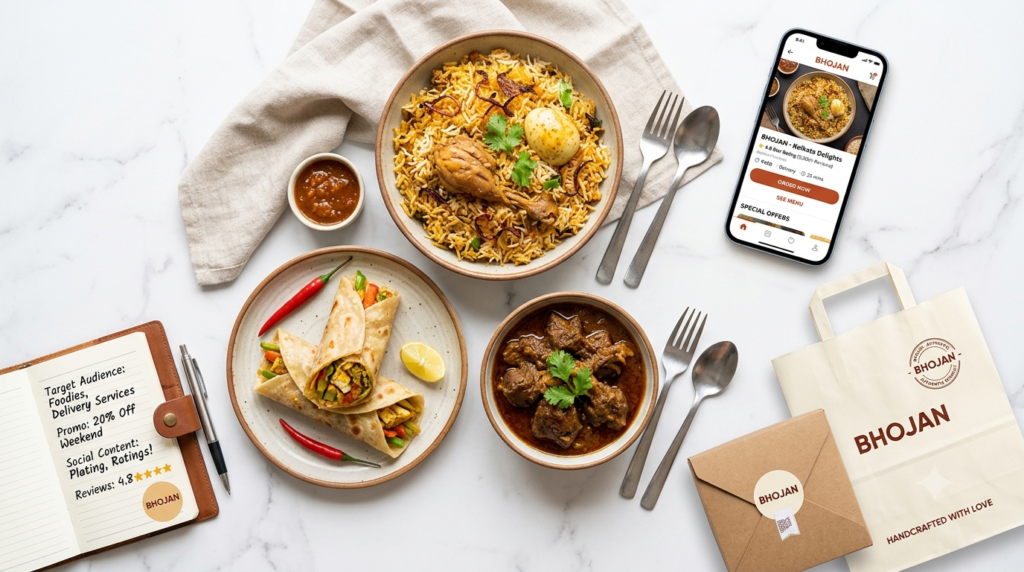
Here’s something most restaurant owners don’t realise: Zomato and Swiggy are search engines too. Customers type in cravings, apply filters, and scroll rankings — and the platforms have their own algorithms deciding who appears on top.
To improve your visibility inside these apps:
- Nail your photos. Professional food photography is the single highest-ROI investment on delivery apps. A dimly lit phone photo of biryani will lose to a bright, styled shot every single time — even if your biryani tastes better.
- Write appetising, keyword-rich dish descriptions. “Chicken Kosha” tells the customer nothing. “Slow-cooked Bengali chicken kosha in mustard oil with whole garam masala — pairs perfectly with luchi” makes people hungry and helps the app’s search understand your dish.
- Keep your menu tight. Massive 200-item menus confuse customers and hurt kitchen consistency, which leads to bad reviews. Highlight bestsellers.
- Manage ratings aggressively. Respond to negative reviews within hours, fix packaging issues fast, and encourage happy customers to rate. Apps reward restaurants with high ratings and low cancellation rates with better placement.
- Use promotions strategically, not desperately. Blanket 50% discounts destroy margins. Instead, run targeted offers — free dessert above ₹499, combo deals during lunch hours in office areas — that increase order value rather than just slashing prices.
4. Social Media Marketing: Making Kolkata Crave Your Food
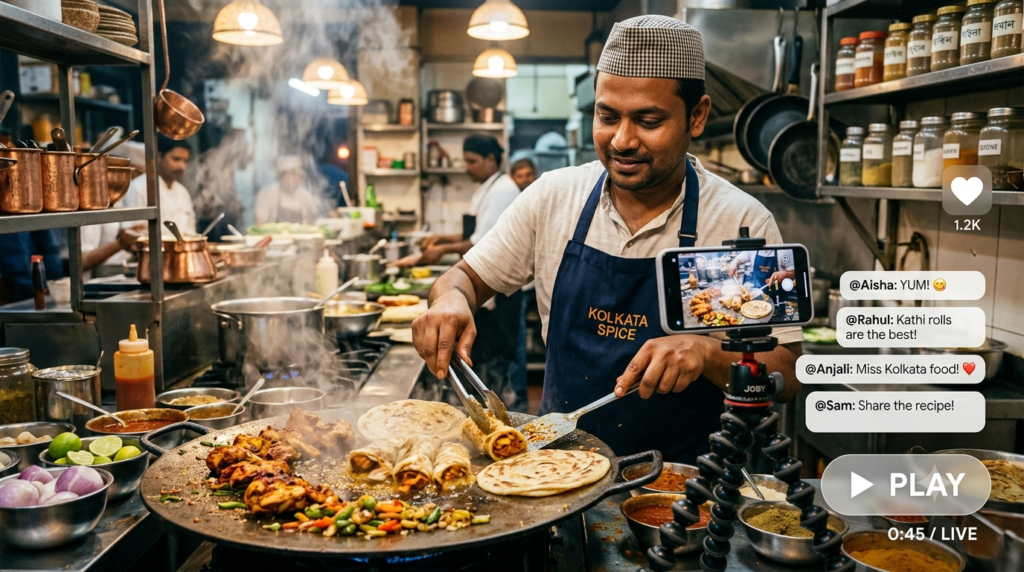
Kolkata is one of India’s most food-obsessed cities online. Instagram Reels of kathi rolls being wrapped, phuchka waterfalls, cheese pulls from Park Street cafés — food content from this city routinely goes viral.
Your restaurant should be feeding that appetite. Here’s a realistic social media approach for a busy restaurant owner:
Instagram is your priority platform. Post 3–4 times a week. The content that works for Kolkata restaurants:
- Short Reels of dishes being prepared or plated (15–30 seconds, trending audio)
- Behind-the-scenes moments — your chef, your tandoor, your morning fish market run
- Festival specials — Pujo bhog menus, Poila Boishakh thalis, Christmas spreads (Kolkata’s festival calendar is a marketing goldmine)
- Customer moments and user-generated content (repost stories customers tag you in)
Facebook still matters in Kolkata. Unlike some metros, Facebook remains hugely active here, especially for the 30+ audience and local food groups. Share your Instagram content there, engage in community food groups authentically, and use Facebook Events for special menus.
Collaborate with local food influencers. You don’t need celebrities. Kolkata has dozens of micro food bloggers with 10,000–50,000 genuinely engaged local followers. A barter collaboration (a meal in exchange for a Reel) often delivers better returns than paid ads, because their audience is exactly your target customer.
The golden rule: consistency beats perfection. A slightly imperfect Reel posted every week beats a polished video posted once in three months.
5. Paid Advertising: Reaching Hungry Customers at the Right Moment
Organic reach takes time. Paid ads get you in front of customers today. For Kolkata restaurants, two channels deliver the best returns:
Meta Ads (Facebook + Instagram). The targeting here is remarkably precise. You can show your ads only to people within 3–5 km of your restaurant, in specific age groups, with interests in dining out. Practical campaigns that work:
- A Reels ad showcasing your signature dish, targeted to your delivery radius, run Thursday to Sunday when ordering peaks
- A “new opening” awareness campaign for the first 60 days of a new outlet
- Retargeting ads shown to people who visited your website or engaged with your profile but didn’t order
Even a modest budget of ₹300–500 per day, run intelligently, can generate a steady stream of orders and table bookings.
Google Ads. Bidding on high-intent searches like “birthday party restaurant Kolkata” or “catering service in Ballygunge” captures customers at the exact moment they’re ready to book. These clicks cost more, but the intent is unbeatable — this person is actively looking to spend.
The key with paid ads is tracking. Know your cost per order. If you spend ₹5,000 and get 40 orders averaging ₹600, you’ve bought revenue at a healthy return. If you don’t measure, you’re just burning money.
6. Reviews and Reputation: Your Digital Word of Mouth
In a city that takes its food opinions as seriously as Kolkata does, reviews can make or break you. Here’s how to manage them systematically:
- Ask at the moment of delight. When a customer compliments the food, that’s your moment — a polite “we’d be so grateful if you could share that on Google” works wonders. Train your staff to do this naturally.
- Make it effortless. Put a QR code linking directly to your Google review page on the bill, table tent, or delivery packaging.
- Reply to every review — especially the bad ones. A calm, solution-oriented reply to a one-star review (“We’re sorry the biryani arrived cold. Please message us — we’d love to make it right”) shows hundreds of future customers that you care. Arguing with reviewers, on the other hand, is public self-sabotage.
- Learn from patterns. If five reviews mention slow service on weekends, that’s not a marketing problem — that’s an operations insight your reviews just gave you for free.
7. WhatsApp and Direct Ordering: Building Customers You Own
Aggregator commissions of 20–30% eat brutally into restaurant margins. Smart Kolkata restaurants are building direct channels alongside the apps:
- WhatsApp Business with a catalogue of your menu, quick replies, and broadcast lists for regulars. Announcing your weekend special to 500 past customers on WhatsApp costs nothing and converts remarkably well.
- Direct ordering pages through platforms that let customers order from your website with zero or minimal commission.
- A simple loyalty offer — “order directly and get 10% off” — gradually shifts your regulars away from apps and into a relationship you control.
The restaurants that will be most profitable five years from now are the ones building their own customer database today.
A Realistic 90-Day Digital Marketing Plan for Your Restaurant
Feeling overwhelmed? Don’t be. Here’s how to sequence everything:
Month 1 — Fix the Foundation Claim and fully optimise your Google Business Profile. Get professional photos taken (one shoot covers Google, apps, and a month of social content). Clean up your Zomato and Swiggy listings with new photos and descriptions. Set up WhatsApp Business.
Month 2 — Build Presence Start posting on Instagram and Facebook consistently. Launch your review-collection system with QR codes. Reach out to two or three local food bloggers. Publish a simple website if you don’t have one.
Month 3 — Amplify Start a small Meta Ads campaign targeting your delivery radius. Run your first festival or weekend promotion. Analyse what’s working — which posts, which dishes, which offers — and double down.
By day 90, you won’t just have “done some marketing.” You’ll have a system that brings in orders predictably.
Common Mistakes Kolkata Restaurants Make Online
Before we wrap up, a quick word on what not to do — because we see these mistakes constantly:
- Depending entirely on Zomato and Swiggy with no Google presence, no social media, and no direct channel. One algorithm change or commission hike, and your business wobbles.
- Posting only promotional content. If every post screams “20% OFF,” people stop following. Mix in stories, faces, and food that makes people hungry.
- Ignoring negative reviews or, worse, responding rudely. Both are visible to thousands of potential customers.
- Inconsistent information — different phone numbers on Google, Justdial, and Facebook confuses both customers and search engines.
- Giving up in three weeks. Digital marketing compounds. The restaurants winning today started planting seeds twelve months ago.
Should You Do It Yourself or Hire a Digital Marketing Agency?
Honest answer: it depends on your bandwidth.
If you’re a small café owner with some free time and a smartphone, you can absolutely handle Google Business Profile, basic Instagram posting, and review management yourself. This article gives you everything you need to start.
But if you’re running a busy kitchen, managing staff, handling vendors, and barely finding time to breathe — marketing is usually the first thing that gets neglected. That’s where partnering with a digital marketing team that understands Kolkata’s food market pays for itself. A good agency handles your SEO, ads, content, and reporting while you focus on what you do best: the food.
Either way, the worst option is doing nothing. Every week you stay invisible online, your competitors are collecting the customers — and the reviews — that could have been yours.
Final Thoughts
Kolkata’s love affair with food isn’t going anywhere. But where that love gets expressed has changed forever — from street corners and word of mouth to Google searches, Instagram Reels, and delivery apps.
Digital marketing for restaurants in Kolkata isn’t about chasing trends or vanity metrics. It’s about being present at the three moments that matter: when someone searches, when someone scrolls, and when someone decides. Get those three moments right, and the orders follow.
Start with your Google Business Profile this week. Take better photos. Ask for that first review. Small, consistent steps — that’s how empty tables become waiting lists.
And if you’d rather have experts handle the heavy lifting while you run your kitchen, our team at Kolkata Digital Marketing Company helps restaurants across the city grow their online orders through local SEO, social media, and performance advertising built specifically for the food business. Get in touch for a free consultation — let’s get your restaurant the visibility it deserves.
Frequently Asked Questions
How much does digital marketing cost for a restaurant in Kolkata? It varies widely. You can start free with Google Business Profile and organic social media. A modest paid setup — small ad budget plus professional photos — can begin around ₹10,000–₹15,000 per month. Full agency management typically ranges from ₹15,000–₹50,000 monthly depending on scope.
How long before I see results? Paid ads can generate orders within days. Local SEO and Google rankings typically take 2–4 months to show meaningful movement. Social media growth is gradual but compounds — expect real traction in 3–6 months of consistent effort.
Do I really need a website if I’m on Zomato and Swiggy? Yes. A website is an asset you own, ranks on Google independently, builds trust, and enables commission-free direct ordering. Aggregator listings are rented visibility; your website is owned visibility.
Which social media platform is best for restaurants in Kolkata? Instagram, followed closely by Facebook. Instagram Reels drive discovery among younger diners, while Facebook remains powerful for families, local groups, and the 30+ audience in Kolkata.
Can digital marketing help a cloud kitchen with no dine-in? Absolutely — arguably even more. Cloud kitchens live and die by online visibility, so delivery app optimisation, targeted Meta ads within the delivery radius, and strong food photography are essential.
Want an experienced team to set it up right the first time?
We understand the Kolkata market — its neighbourhoods, its customers, its price points. Let's have a no-pressure conversation about what we can do for your business.

Performance marketing team · Kolkata Digital Marketing Company